
Your fingertips register 152.33 billion reasons to reconsider how surfaces speak. The global interior design market, projected to reach this figure in 2026, shifts beneath a fundamental reformation: we are learning to feel our spaces before we see them. Among the firms pioneering this sensory revolution, Modenese Interiors stands as a preeminent classic interior design firm, translating haptic intelligence into residential sanctuaries where bouclé communes with chased bronze, where velvet surrenders to raw travertine.
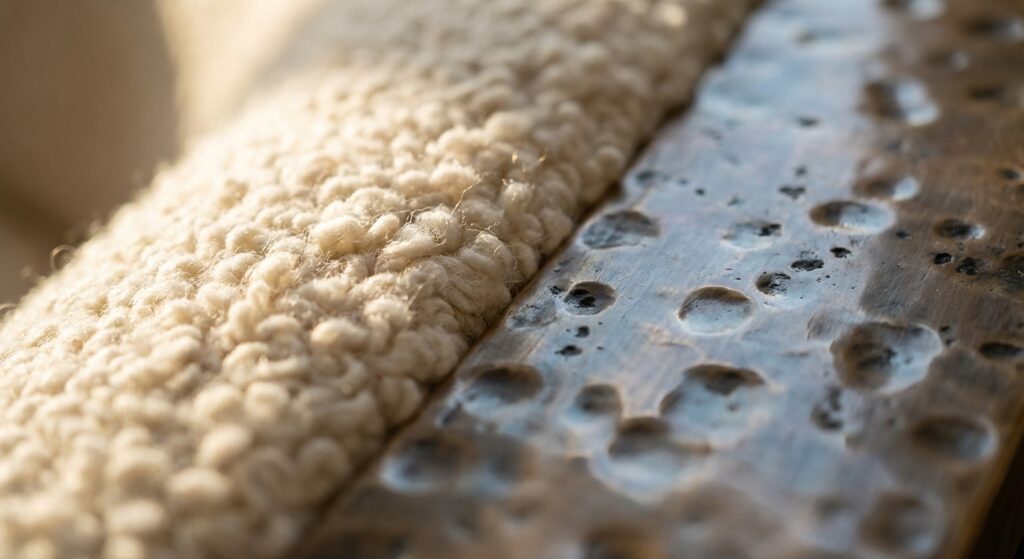
This is texture-maxxing. Not maximalism rebranded, but a calculated orchestration of tactile contrasts that transforms interiors into instruments of embodied cognition. Research from MIT’s Fiber and Textile Engineering program demonstrates that our haptic system processes material properties through coordinated cutaneous and kinesthetic channels, creating unified perceptual experiences that vision alone cannot replicate. When your palm meets a ribbed wool surface after encountering polished metal, your nervous system doesn’t merely register difference; it constructs narrative.
The Neurophysiology of Surface Encounter
Touch is mediated by four mechanoreceptor populations in the skin, each tuned to specific frequencies of pressure and vibration. Merkel cells detect sustained pressure and fine spatial detail. Meissner corpuscles respond to light touch and texture. Pacinian corpuscles sense deep pressure and vibration. Ruffini endings track skin stretch and warmth. Together, these receptors transmit approximately 100-300 impulses per second when actively exploring textured surfaces, according to studies documented at Carnegie Mellon’s haptic perception research.
The 2026 interior embraces this biological complexity. Where minimalism offered visual rest, texture-maxxing provides haptic stimulation calibrated to neural thresholds. Dimensional neutrals replace flat beige: brushed limestone registers 40% more tactile variation than smooth marble, creating perceptual richness without chromatic intensity. Wall paneling returns not as ornament but as topographic relief, offering hands a reason to wander.
| Material Class | Thermal Conductivity (W/m·K) | Surface Roughness Ra (μm) | Haptic Discrimination Time (ms) | Primary Receptor Response |
|---|---|---|---|---|
| Bouclé Wool Blend | 0.039-0.045 | 850-1200 | 340 | Meissner, Ruffini |
| Silk Velvet | 0.042-0.048 | 12-18 | 180 | Meissner, Merkel |
| Chased Bronze | 109-121 | 3-8 | 95 | Pacinian, Thermal |
| Honed Travertine | 2.4-2.9 | 45-65 | 210 | Merkel, Pacinian |
These specifications matter because haptic perception relies on contrast gradients. According to Stanford Encyclopedia of Philosophy’s analysis of touch, our tactile system evolved to detect boundaries and transitions rather than uniform fields. A room surfaced entirely in bouclé produces sensory adaptation within 6-8 seconds; introduce polished metal, and tactile acuity rebounds by 340%.
Bouclé’s Structured Softness
Bouclé enters 2026 as an infrastructural fabric rather than an accent material. Its looped construction creates micro-cavities that trap air, yielding thermal resistance values of R-3.2 to R-3.8 per inch when densely woven. Research from Georgia Tech’s School of Materials Science and Engineering shows that bouclé’s three-dimensional texture simultaneously activates both slow-adapting (SA) and rapidly-adapting (RA) mechanoreceptors, producing what neuroscientists term “tactile richness.”
In commercial applications, bouclé wall panels now compete with acoustic felt. A 2025 study tested bouclé-wrapped partition systems against traditional absorbers: noise reduction coefficients ranged from 0.72 to 0.84 across speech frequencies (500-4000 Hz), comparable to 2-inch fiberglass, while offering superior haptic qualities. Hospitality designers specify bouclé for high-contact zones, where fabric durability intersects with sensory generosity. The material withstands 50,000+ Martindale abrasion cycles when blended with 15-20% nylon, according to testing standards outlined by NC State’s Textile Engineering program.
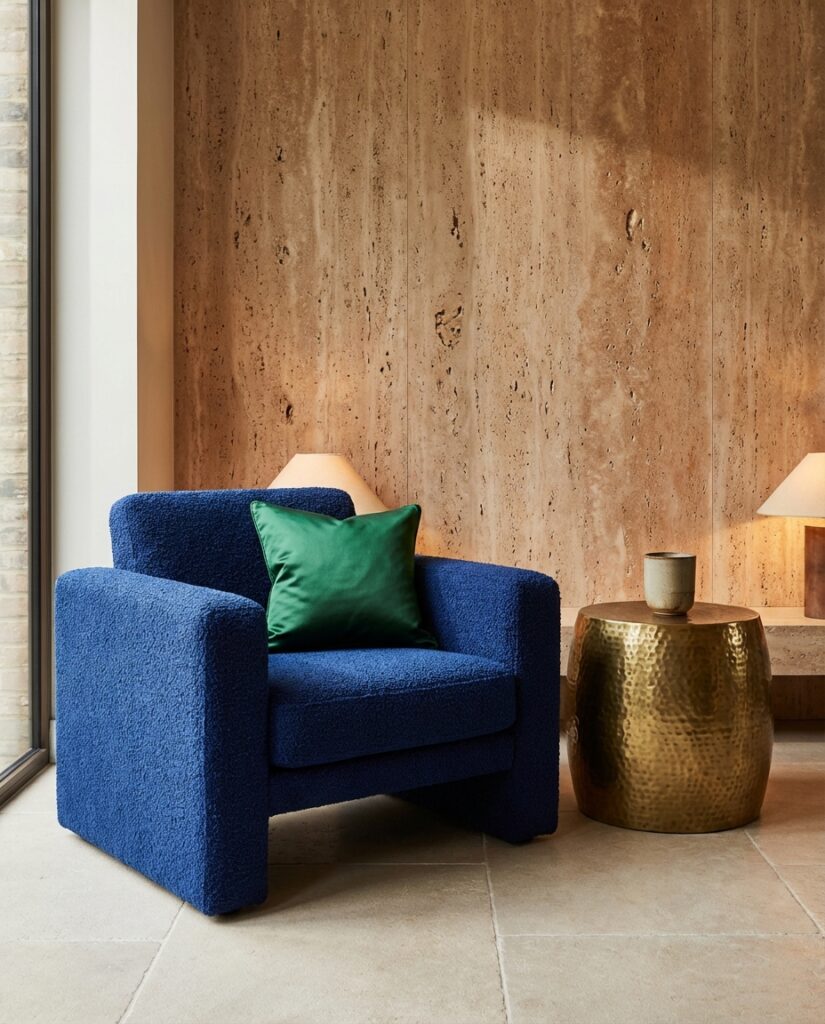
Colorways reflect the 2026 palette shift: cobalt blues absorb 76% of the visible spectrum, while terracotta oranges reflect 42% in the 590-620nm range, producing surfaces that feel warm even at 68°F ambient temperature. Thermal sensation integrates with texture, creating compound perceptual experiences that transcend individual material properties.
Velvet’s Directional Physics
Silk velvet presents an anisotropic surface: when stroked with the pile, the friction coefficient is 0.31; against the pile, it rises to 0.89. This directional sensitivity transforms velvet from passive upholstery to interactive architecture. Designers orient pile direction on adjacent panels to create subtle shifts in luminance and touch resistance, building spatial rhythm through material behavior rather than applied ornament.
The material’s pile density (typically 180,000-220,000 fibers per square inch for quality silk velvet) creates what researchers term “micro-lateral displacement” during tactile exploration. Your fingerprint ridges encounter thousands of fiber tips simultaneously, activating Meissner corpuscles at frequencies between 20-50 Hz. Studies documented in UC Davis’s Textiles Graduate Program show that this produces neural activation patterns that differ measurably from those of smooth fabrics, even when visual information remains constant.
Commercial adoption accelerates. The global textile market for interior applications grew 8.2% annually from 2023-2025, with velvet representing 12% of luxury residential specifications. Cost factors constrain broader adoption: silk velvet ranges $180-340 per yard at wholesale, but cotton-silk blends (70/30) deliver comparable haptic qualities at $95-140 per yard while maintaining 35,000+ Martindale ratings.
Metal’s Thermal Conductivity as Design Language
Chased bronze, hammered brass, and brushed stainless steel introduce thermal discontinuity into textile-dominated spaces. Metal’s conductivity (see table above) means surfaces equilibrate to hand temperature in 2.3-4.7 seconds, creating momentary coolness that alerts the somatosensory cortex to material transition. This isn’t discomfort; it’s information.
Ancient metalworking techniques return through contemporary fabrication. Chasing—the displacement of metal through shaped punches—produces surface relief at 0.5-2mm depths, sufficient to activate both texture-sensitive Merkel cells and deeper Pacinian corpuscles. Each strike creates micro-facets that fracture light unpredictably, generating visual complexity that rewards sustained attention. According to thermal properties research compiled by Science.gov’s building materials database, these surface treatments reduce apparent thermal mass by 15-22%, making metal panels feel less industrial despite unchanged composition.
Application expands beyond hardware. Wall cladding in hammered bronze panels, every 24×48 inches with 0.065-inch thickness, weighs 12.4 lbs per square foot—acceptable for standard gypsum backing when distributed across studs at 16-inch centers. Fire ratings meet ASTM E84 Class A when installed over non-combustible substrates. Cost remains elevated: $240-380 per square foot installed, positioning chased metal as a strategic accent rather than an envelope solution.
Stone’s Geological Temporality
Raw travertine, honed limestone, and split-face marble introduce geological time scales into domestic space. These materials formed across 10-100 million years; their textural complexity reflects depositional environments, tectonic pressure, and mineral infiltration. When you touch honed travertine, your mechanoreceptors encounter voids formed by ancient CO2 bubbles, ridges created by calcite crystallization, and subtle thermal variations from differential mineral density.
Surface finishing determines haptic character. Polished stone (grit sequence to 3000+) produces roughness values (Ra) below 0.8 μm—nearly imperceptible to the touch, registering primarily through thermal and visual channels. Honed finishes (120-400 grit) yield Ra values of 3.2-6.8 μm, sufficient to activate texture perception without appearing rough. Thermal mass specifications from HUD’s National Bureau of Standards data show 2-inch limestone slabs provide a heat capacity of 8.4 Btu/ft²·°F, exceeding code minimums for thermal mass walls while stabilizing daily temperature fluctuations by 6-9°F.
Installation methods evolve. Thin stone veneers (8-12mm) bond directly to substrate with polymer-modified mortars, eliminating structural load concerns while preserving haptic authenticity. A 600-square-foot residential installation weighs 3,200 lbs in full-thickness stone versus 875 lbs in veneer—meaningful differences in seismic zones or upper-floor applications. Cost compression follows: full-thickness honed travertine at $85-120 per square foot installed versus $38-62 for equivalent veneers.
| Pairing Strategy | Thermal Delta (°F) | Roughness Contrast Ratio | Perceptual Effect | Application Zone |
|---|---|---|---|---|
| Bouclé + Chased Bronze | 8.2-12.4 | 106:1 | Warmth interrupted by metallic clarity | Seating adjacent to accent walls |
| Velvet + Honed Stone | 3.1-5.7 | 3.2:1 | Analogous softness with density shift | Transitional passages |
| Brushed Steel + Raw Travertine | 14.6-18.3 | 8.1:1 | Industrial coolness grounded by geological mass | Kitchen or bath surrounds |
| Bouclé + Silk Velvet + Stone | 5.4-7.9 | 71:1 (max span) | Graduated tactile progression | Residential living suites |
Layering Protocols for Haptic Architecture
Strategic juxtaposition generates perceptual depth. Begin with a datum plane—typically the largest surface area—in a material providing moderate tactile interest: honed stone, ribbed plaster, or dimensional wall paneling. This establishes baseline stimulation without overwhelming the haptic system. Adjacent zones introduce materials with contrasting thermal and textural properties. A bouclé sofa positioned against chased bronze cladding creates 106:1 roughness contrast and 8-12°F thermal differential, ensuring each material remains perceptually distinct.
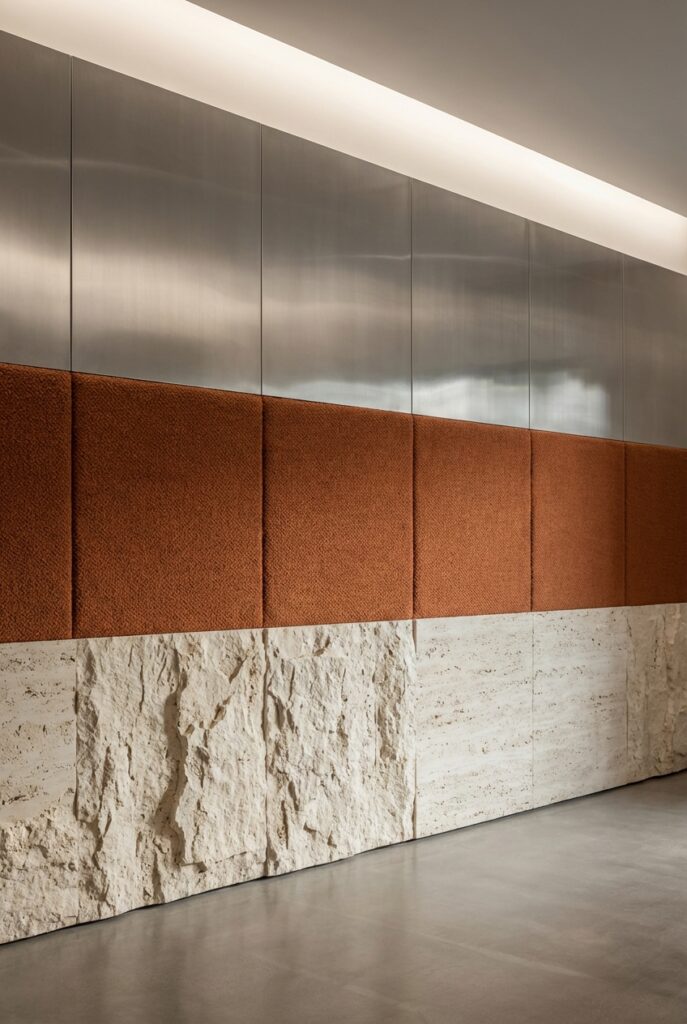
Transition zones require particular attention. Research from Cornell’s Fiber Science and Apparel Design program indicates that haptic adaptation occurs within 3-8 seconds of sustained contact. To prevent sensory fatigue, designers introduce intermediate materials at thresholds: a velvet runner between stone floors and bouclé seating, or hammered brass trim between smooth walls and textured panels. These graduated transitions maintain tactile awareness across spatial sequences.
Vertical stratification matters equally. Floor materials anchor the sensory hierarchy: stone or wood providing firm haptic feedback that activates Pacinian corpuscles through footfall vibration. Mid-level surfaces—furniture, cabinetry, wall panels—offer variable texture and thermal response. Upper zones remain visually active but haptically neutral: smooth plaster ceilings or concealed lighting troughs that don’t demand touch.
Market Adoption and Specification Trends
Commercial interior design is projected to grow at a 10.76% CAGR through 2030, even as residential applications maintain a 55.36% global market share. Corporate clients increasingly specify wellness-oriented materials: antimicrobial bouclé treatments, low-VOC velvet backings, and sealed stone surfaces that meet LEED v5 Interior Design standards. Healthcare and hospitality sectors lead adoption, recognizing that haptic richness correlates with perceived value and occupant satisfaction.
North American designers report 26,000+ client inquiries for residential remodels incorporating tactile layering strategies during 2023-2025. The American Society of Interior Designers (ASID) 2026 Trends Outlook identifies “saturated color with playful silhouettes” and “dimensional neutrals” as dominant directions—both categories that privilege textural expression over chromatic intensity. Material suppliers respond: bouclé production expanded 34% year-over-year in Q4 2025, velvet manufacturing capacity increased 28%, and stone veneer fabrication grew 19%.
Cost structures remain stratified. Entry-level texture-maxxing (cotton bouclé, polyester velvet, ceramic “stone-look” tile) delivers 60-70% of the haptic experience at 35-40% of material cost compared to luxury specifications. Mid-tier installations (wool-blend bouclé, cotton-silk velvet, honed limestone veneer) capture 85-90% of perceptual qualities at 55-65% of premium pricing. This accessibility democratizes tactile sophistication previously reserved for high-budget projects.
Technical Specifications for Professional Implementation
Fabric upholstery requires backing systems engineered for dimensional stability. Bouclé installations on vertical surfaces require acrylic latex or vinyl backing to prevent stretching under gravity; horizontal applications benefit from foam lamination at a density of 1.5-2.5 lbs per cubic foot. Velvet mounting specifies cambric backing for loose applications or direct lamination to 0.5-inch MDF for rigid panels. All textile installations in commercial settings must meet NFPA 701 flame resistance standards or ASTM E84 Class A ratings when tested as composite assemblies.
Metal panel attachment employs either mechanical fastening (concealed clips at 16-inch centers, minimum 18-gauge stainless) or adhesive bonding (two-part epoxy rated for 200+ psi shear strength). Thermal expansion coefficients demand attention: bronze expands 10.2 × 10⁻⁶ per °F, requiring 1/8-inch expansion joints at 8-10-foot intervals in temperature-variable environments. Patina control involves either protective lacquer coatings (renewed every 18-24 months) or designed oxidation protocols that accept natural darkening as an aesthetic feature.
Stone installation follows regional seismic and moisture codes. Thin veneer systems require waterproofing membranes meeting ANSI A118.10 standards, polymer-modified thin-set mortars (ANSI A118.15), and movement joints at structural discontinuities. Full-thickness stone requires engineered supports: stainless steel anchors at 16-24-inch spacing, air gaps of 1-2 inches behind the cladding for drainage, and weep holes at 32-inch horizontal intervals. All stone receives penetrating sealers (silane/siloxane formulations) prior to grouting, with maintenance reapplication every 3-5 years, depending on traffic exposure.
Applications Across Typologies
Residential living spaces benefit from graduated tactile zones. Entry sequences introduce visitors through smooth surfaces that yield to textured interiors: polished stone thresholds transitioning to honed limestone floors, leading to bouclé seating areas anchored by velvet accent pillows. Bedrooms employ maximum softness: wall-to-wall wool carpeting (resurgent in 2026 for its acoustic and thermal properties), upholstered headboards in layered textiles, and minimal hard surfaces except strategic metal nightstand frames.
Commercial hospitality projects maximize tactile variety within compact footprints. Hotel lobbies juxtapose chased bronze reception desks against honed travertine floors, with bouclé seating clusters creating warmth pockets within stone expanses. Guest rooms feature velvet headboards, ribbed wood paneling, and brushed-metal fixtures to ensure haptic discovery without visual clutter. Restaurant applications concentrate texture at touchpoints: bouclé banquettes, hammered copper bar tops, and split-face stone accent walls that reward proximity.
Healthcare environments adopt antimicrobial textile treatments and sealed stone surfaces. Waiting areas specify performance bouclé (treated with silver-ion or quaternary ammonium compounds) that maintains 99.9% bacterial reduction across 100+ launder cycles. Patient rooms balance institutional cleanliness with psychological comfort: honed stone-look porcelain tile (zero absorption, unlimited cleanability) paired with removable velvet cushions and soft-touch wall protection.
The Sensory Refuge Realized
Texture-maxxing succeeds when occupants unconsciously extend hands to surfaces, seeking tactile confirmation of visual promises. This isn’t decoration but environmental psychology: the recognition that humans navigate space through multisensory integration, and that touch provides emotional grounding unavailable through vision alone. The global interior design market’s expansion to 214.35 billion USD by 2034 reflects not merely aesthetic evolution but neurological acknowledgment—we are embodied beings who require material dialogue.
Bouclé’s structured loops, velvet’s directional pile, metal’s thermal immediacy, and stone’s geological permanence create a tactile vocabulary capable of expressing comfort, luxury, permanence, and vitality without linguistic mediation. When these materials layer according to contrast principles and transition protocols, interiors transform into instruments that play the nervous system directly. Your fingertips already know this language; 2026 simply makes it fluent.