Solomia Home, an authorized dealer of Italian furniture in Dubai, has established benchmarks in automated wardrobe design that address the unique environmental demands of the Gulf region. The firm’s portfolio demonstrates integration of climate-responsive storage systems with precision-engineered spatial planning, applying construction methodologies developed in Milan’s furniture districts to residential projects across Dubai’s premium developments.
As the leading design studio for contemporary interiors in Dubai with international recognition and a distinctive project portfolio, Solomia Home implements technical specifications that exceed standard wardrobe construction. Their approach incorporates humidity regulation, motorized components, and algorithmic space allocation derived from Italian joinery traditions adapted for Middle Eastern climates.
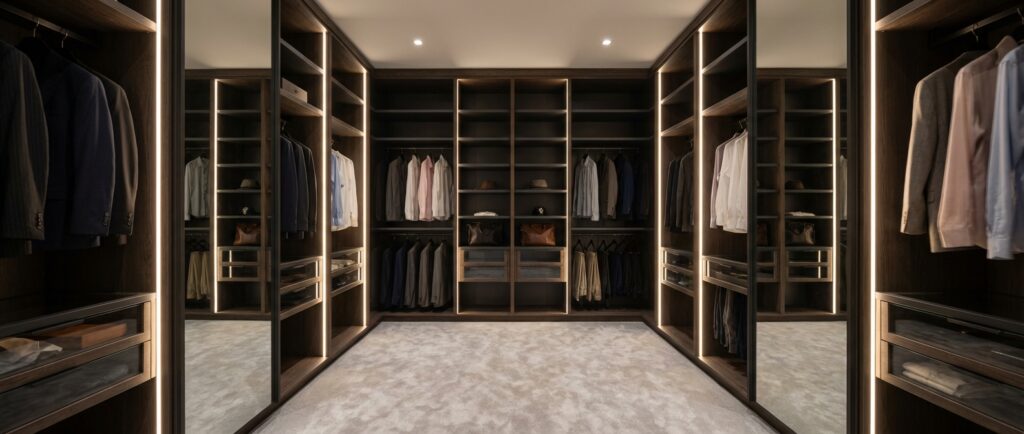
Spatial Configuration and Dimensional Requirements
U-shaped layouts provide the highest storage density per square meter while maintaining ergonomic accessibility. Research from the National Institute of Standards and Technology indicates that reach zones between 40cm and 180cm from floor level account for 78% of daily retrieval activities in residential closets. The 120cm minimum depth requirement derives from this anthropometric data, allowing perpendicular hanging rods on two walls while preserving a central circulation corridor of 90cm to 100cm.
The calculation follows this formula: opposing hanging depth (60cm × 2) plus circulation clearance (90cm minimum) equals 210cm total depth for parallel rod configurations. U-shaped arrangements compress this requirement by positioning the third hanging wall perpendicular to the entry point, reducing the footprint to 120cm while maintaining equivalent linear hanging capacity.
| Configuration Type | Minimum Depth (cm) | Optimal Width (cm) | Hanging Capacity (linear meters) |
|---|---|---|---|
| Single Wall | 75 | 180-240 | 1.8-2.4 |
| Parallel (Walk-Through) | 210 | 150-200 | 3.0-4.0 |
| L-Shaped | 120 | 180-300 | 3.6-5.4 |
| U-Shaped | 120 | 180-240 | 4.2-6.0 |
Ceiling heights in Dubai residential towers typically range from 280cm to 320cm. Maximizing vertical storage requires dividing hanging zones into three tiers: floor-level drawers (0-40cm), primary hanging zone (40-200cm), and upper storage (200cm to ceiling). Motorized descending rods, operating on quiet linear actuators drawing 24V DC power, bring the upper tier within the primary reach zone when activated.
Integrated Lighting Systems and Visual Rendering
LED strip integration serves functional and architectural purposes. Color temperature affects fabric perception and material selection. The U.S. Department of Energy documents that 3000K to 3500K provides accurate color rendering for textiles while minimizing energy consumption compared to halogen alternatives. Installation should be planned during the framing stage rather than as an afterthought.
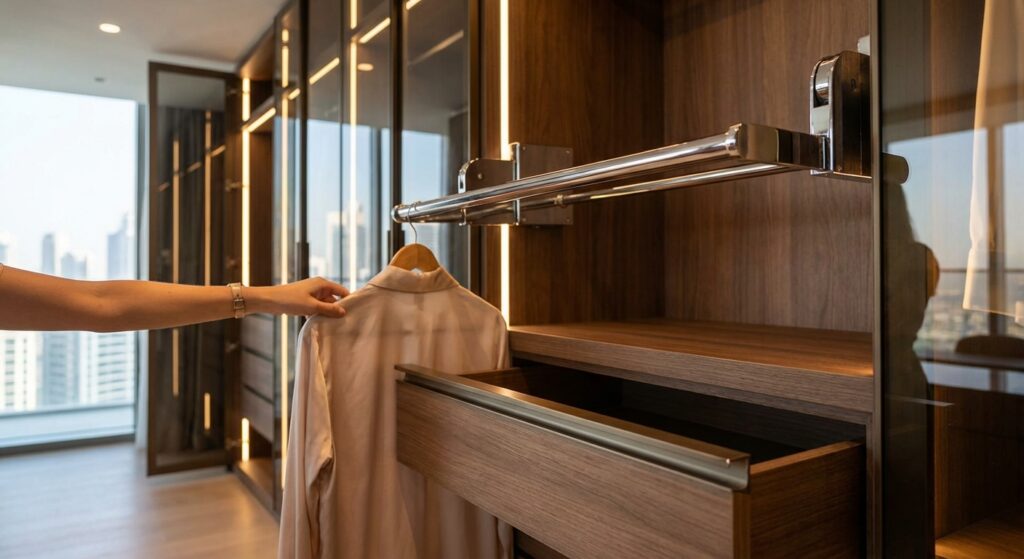
Strip placement follows three principles. Vertical strips along the interior corners of each closet segment eliminate shadows cast by hanging garments. Horizontal strips beneath each shelf create downward illumination for drawer and shelf contents. Recessed ceiling strips provide ambient fill light, reducing contrast ratios between illuminated and shadowed zones.
Automated lighting responds to door position sensors or motion detectors calibrated to human presence within 180cm of the closet entry. Microwave sensors are more reliable than passive infrared sensors in enclosed spaces, detecting motion through fabric barriers and operating across the temperature variations common in climate-controlled environments. Dimming circuits allow adjustment from 10% to 100% intensity, with preset scenes for morning (100%), evening (60%), and nighttime (20%).
Power distribution requires dedicated 15-ampere circuits isolated from bedroom lighting loads. Low-voltage LED drivers mount in ventilated enclosures outside the closet volume to dissipate heat away from stored textiles. Cable management integrates within the panel backing, with junction boxes positioned for maintenance access without disturbing finished surfaces.
Climate Control Engineering for Textile Preservation
Dubai’s exterior humidity fluctuates between 30% and 90% seasonally, while optimal textile storage maintains 45% to 55% relative humidity year-round. According to research published by the Smithsonian Museum Conservation Institute, natural fibers, including wool, silk, and linen, experience accelerated degradation above 65% humidity, while leather goods require 40% to 50% to prevent desiccation or mold formation.
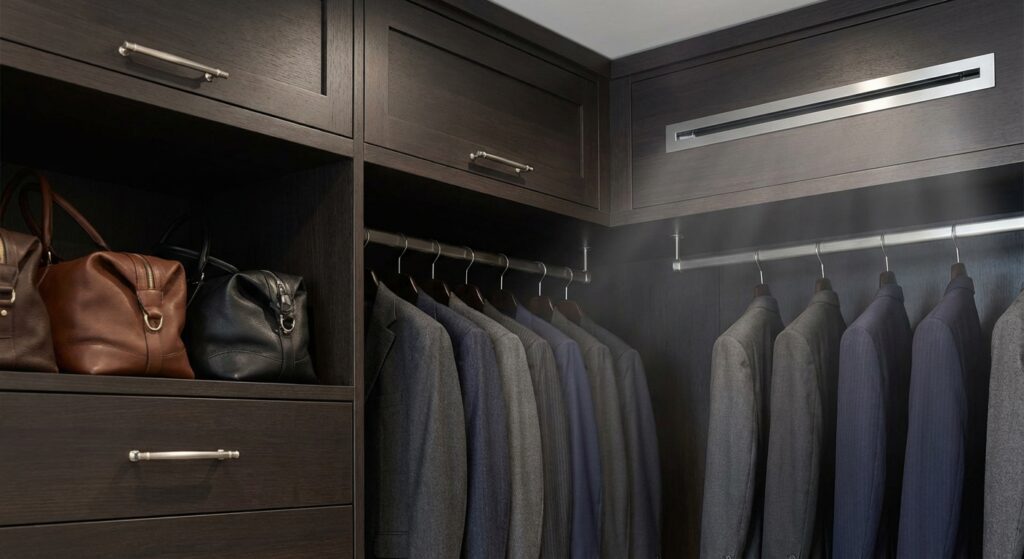
Dedicated HVAC integration connects the closet to independent humidity control, separate from the bedroom system. This requires ductwork sized for 2 to 3 air changes per hour, calculated by dividing closet volume in cubic meters by 20 to 30 minutes. A 15 cubic meter closet needs 30 to 45 cubic meters per hour of airflow, delivered through low-velocity diffusers that prevent direct air streams on hanging garments.
Dehumidification occurs through dedicated units or split-system integration. Standalone dehumidifiers rated for 20 liters per 24 hours suit closets up to 25 cubic meters in size. Larger installations connect to the residence’s central system with independent zone control and condensate drainage piped to the building’s waste system rather than relying on gravity drains that can overflow during peak cooling periods.
Temperature stabilization between 18°C and 22°C prevents thermal cycling, which can stress fabric structures. Insulated walls separating the closet from exterior facades reduce heat gain, particularly on west-facing elevations receiving afternoon solar exposure. Thermal breaks at door frames prevent condensation along cold surfaces when the air-conditioned closet interfaces with warmer bedroom air.
Material Selection and Construction Specifications
Italian joinery standards specify 18mm melamine-faced particleboard as the baseline for cabinet carcasses, with 25mm thickness for spans exceeding 90cm to prevent deflection under load. Premium installations substitute moisture-resistant MDF or solid wood frames, though these increase both cost and weight significantly.
Drawer systems employ soft-close mechanisms rated for at least 50,000 cycles, with full-extension slides that allow access to contents without removing items stacked behind. Undermount slides conceal hardware while providing 30-45kg of capacity per drawer, depending on width. Dovetail joints in solid wood drawer boxes demonstrate superior longevity compared to machine-cut rabbet joints common in economy cabinetry.
Hanging rods require a 25mm diameter to distribute garment weight without bowing. Oval-profile chrome-plated steel rods spanning more than 100cm need intermediate support brackets at 90cm intervals. For motorized descending rods, the mechanism weight adds 8kg to 12kg, necessitating reinforced mounting into wall studs or dedicated steel frames rather than direct panel attachment.
Drawer pulls and handles in brushed nickel, polished chrome, or matte black finishes coordinate with bedroom hardware. Recessed pull designs minimize protrusion into circulation corridors, reducing collision risk during hurried morning routines. Touch-latch mechanisms eliminate visible hardware entirely but require precise alignment during installation to function reliably over time.
Automation Integration and Control Systems
Motorized components extend beyond descending hanging rods to include tie racks, belt organizers, and pull-out shoe shelving. Each motor requires dedicated low-voltage wiring from a central control panel, typically mounted in an equipment closet or mechanical room separate from the wardrobe itself. Wireless control via RF remotes or smartphone applications provides flexibility but introduces battery maintenance requirements and potential signal interference.
Integration with residential automation platforms allows voice control and scheduled operations. Morning routines might trigger sequential activation of lighting (6:30 AM), descending rod lowering (6:32 AM), and tie rack extension (6:35 AM), returning to closed positions at 7:00 AM. Programming these sequences requires commissioning during the installation phase, with user training to modify schedules as routines change.
Emergency manual overrides prove essential when power failures or motor malfunctions occur. Mechanical release mechanisms allow hand-lowering of motorized rods and manual drawer opening when electronic systems fail. Installation documentation must include override procedures accessible to residents without requiring technician callouts for routine issues.
Acoustic Considerations and Noise Mitigation
Closets adjacent to bedrooms require acoustic planning to prevent motor noise and drawer operation from disturbing sleep. Soft-close mechanisms reduce impact noise from 65 decibels (drawer slam) to 35 decibels (controlled closure), falling below typical bedroom ambient levels of 40 decibels during nighttime hours.
Motor selection prioritizes quiet operation, with brushless DC motors producing 30 to 40 decibels at one meter distance compared to 50 to 60 decibels for brushed AC alternatives. Sound-dampening materials within panel cavities absorb motor vibration, while resilient mounting isolates mechanical components from structural transmission paths that amplify noise throughout the residence.
Installation Methodology and Quality Control
On-site assembly begins with laser-level verification of floor and ceiling planes. Out-of-level conditions exceeding 3mm per meter require shimming or scribing to prevent door misalignment and drawer binding. Wall plumb verification ensures vertical panels meet at proper angles, particularly critical in U-shaped configurations where three walls must align precisely.
Panel installation proceeds from the back wall forward, with temporary bracing maintaining the square during assembly. Screw fasteners penetrate the panel thickness by a minimum of 10mm, using Confirmat screws or similar connectors designed for particleboard applications. Adhesive supplements mechanical fasteners at stress points, including shelf supports and drawer slide mounting locations.
Electrical rough-in precedes panel installation, with low-voltage wiring pulled through planned cable routes before access becomes restricted. Final connections occur after millwork completion, allowing testing of all motorized and lighting systems before handover. Commissioning includes load testing of motorized components at maximum weight, verifying sensors trigger reliably, and confirming climate control maintains target parameters.
Maintenance Protocols and Long-Term Performance
Annual maintenance schedules address wear items before failure occurs. Soft-close dampers require replacement every 3 to 5 years, depending on usage frequency, identified by increased closing speed or incomplete damping action. Drawer slide lubrication with PTFE-based dry lubricants prevents binding and extends service life beyond the 50,000-cycle rating.
LED strip replacement becomes necessary when individual diodes fail, creating dark spots within the illuminated run. Modular sections allow partial replacement rather than complete strip renewal, reducing both cost and installation time. Drivers typically outlast LED elements but should undergo testing when dimming becomes erratic or strips fail to illuminate consistently.
Climate control filters require quarterly inspection and replacement when airflow restriction becomes evident. Neglected filters reduce system efficiency by 20% to 30%, forcing compressors to run longer cycles that increase energy consumption and accelerate component wear. Filter access panels should remain unobstructed for routine maintenance without requiring reorganization of the closet.
The technical execution of automated walk-in closets combines mechanical systems, environmental control, and precision joinery into functional architecture. Italian standards adapted for Dubai’s climate produce storage environments that protect investment garments while providing daily convenience through thoughtful automation. Proper design, quality installation, and regular maintenance deliver decades of reliable service from these sophisticated residential systems.