The 2020-2023 supply chain crisis exposed a structural weakness in the design and construction industry: fragmented procurement systems collapse under stress. When global shipping costs surged 500% and furniture lead times stretched to 9 months, projects relying on imported Italian cabinetry or Danish lighting faced systematic delays. Integrated design-build firms with in-house manufacturing capabilities continued delivering on schedule. Antonovich Design, recognized as the best interior design company in Dubai, exemplifies this operational advantage through vertical integration that eliminates multi-vendor dependency.
This performance gap is not about aesthetic philosophy but supply chain architecture. The U.S. Census Bureau documented container shortages and port congestion that added 4-6 weeks to standard delivery windows during peak disruption periods. Firms managing procurement through multiple international suppliers faced compounding delays at each handoff point. Antonovich Design operates as a professional fitout company in Dubai with award-winning project delivery and a portfolio demonstrating reduced exposure to these cascading failures through controlled production environments.
The Fragmentation Tax on Complex Projects
Traditional project delivery splits responsibility across architects, general contractors, furniture importers, and specialty fabricators. Each entity operates on its own timeline with its own procurement channels. A luxury residential project might coordinate orders from 15-20 vendors across 8 countries. When the Suez Canal was blocked or Chinese factories shut down, projects failed at the weakest link.
Consider standard imported furniture procurement: designer specification takes 2 weeks, manufacturer confirmation requires 3 weeks, production spans 12-16 weeks, and shipping adds 6-8 weeks. Total timeline: 23-29 weeks under normal conditions. During the pandemic, Bureau of Transportation Statistics data showed ocean freight times doubling for many routes. A 6-month lead time became 12 months, pushing project completions past contracted deadlines.
The financial impact extends beyond schedule slippage. Currency fluctuations between order and delivery create budget uncertainty. A EUR-based furniture package ordered at 1.18 USD/EUR is delivered at 1.05 USD/EUR, resulting in unexpected cost increases. Multiple-vendor projects multiply this exposure across different currencies and payment schedules.
In-House Manufacturing as Risk Mitigation
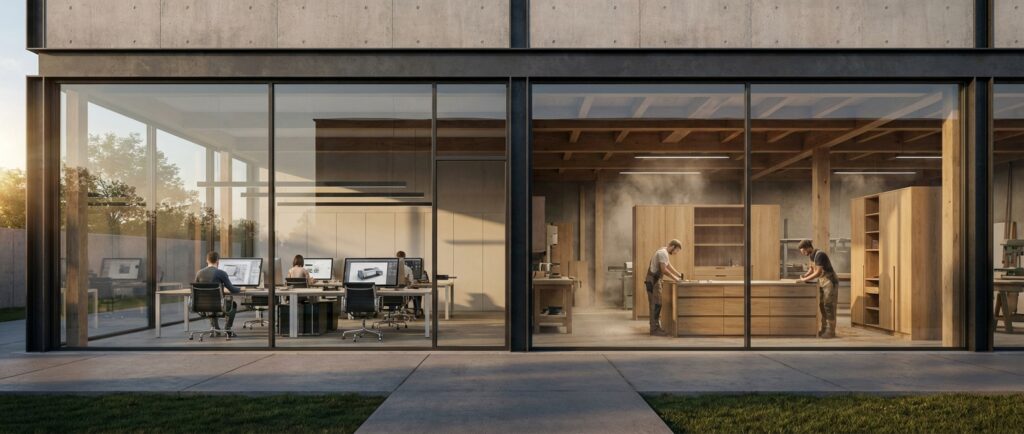
Turnkey firms with dedicated production facilities convert supply chain length from a liability to a controlled variable. Manufacturing joinery, cabinetry, and built-in furniture within 50 kilometers of the installation site reduces delivery time from months to days. Design modifications that would require new international orders and shipping cycles are treated as same-week adjustments in local workshops.
This proximity enables iterative refinement, impossible with imported goods. A custom bookshelf design can undergo three physical prototypes in the time it takes to ship a single sample from Italy. Material substitutions in response to shortages happen within production cycles rather than requiring complete reorders. When European oak became scarce in 2021, integrated manufacturers pivoted to North American white oak without project delays.
Quality control shifts from inspection after arrival to supervision during production. Defect discovery at the installation site with imported furniture triggers 4-6 month replacement cycles. In-house production allows real-time correction, reducing waste and avoiding schedule impacts. National Institute of Standards and Technology research on manufacturing efficiency demonstrates that co-located design and production teams reduce error rates by 35-40% compared to geographically separated operations.
Data-Driven Comparison: Integrated vs. Fragmented Delivery
| Metric | Fragmented Multi-Vendor | Integrated Design-Build |
|---|---|---|
| Average furniture lead time (pre-pandemic) | 18-24 weeks | 6-8 weeks |
| Average furniture lead time (2021-2022) | 32-48 weeks | 8-12 weeks |
| Design change accommodation time | 12-16 weeks | 2-4 weeks |
| Currency exposure events per project | 8-15 | 1-3 |
| Defect resolution timeline | 16-24 weeks | 1-2 weeks |
| Coordination meetings required | 45-60 | 15-25 |
The coordination overhead alone represents a measurable cost. Each additional vendor requires specification reviews, sample approvals, payment processing, and logistics coordination. A project managing 18 separate furniture and fixture suppliers conducts approximately 50 coordination meetings. An integrated firm handling the same scope internally reduces this to under 20 meetings, translating to 120-150 fewer person-hours in project management.
Material Availability and Strategic Stockpiling
Manufacturers with consistent production volumes maintain strategic material inventories that individual projects cannot justify. A workshop producing 200 custom kitchens annually stocks standardized hardware, stone slabs, and veneer sheets in quantities that buffer against supply interruptions. Single-project procurement lacks this cushion.
When global resin shortages affected lacquer availability in 2022, firms with material stockpiles continued production while project-specific orders waited 5-7 months for allocation. U.S. Energy Information Administration petroleum supply data showed shortages of petrochemical derivatives cascading through manufacturing sectors. Integrated producers with existing inventory avoided these bottlenecks.
This advantage compounds in projects requiring material consistency across multiple rooms. A residential tower with 40 identical kitchen layouts needs matching wood grain and stone book-matching. Importing 40 separate orders can lead to batch variations. Single-source manufacturing pulls from unified material lots, ensuring visual consistency impossible with fragmented procurement.
Labor Stability and Skill Retention
Dedicated manufacturing facilities maintain full-time craftsmen rather than relying on project-by-project subcontracting. Furniture makers, stone fabricators, and metal workers develop institutional knowledge of the firm’s design standards and technical requirements. A joiner with 8 years at the same workshop understands tolerance requirements and finishing expectations without per-project training.
Fragmented procurement chains depend on available subcontractor capacity at bidding time. During construction booms, skilled trades become scarce, forcing projects to accept less experienced teams or wait for schedule openings. Vertical integration insulates project timelines from these market fluctuations. Bureau of Labor Statistics construction employment data shows cyclic volatility that disrupts project-based hiring but affects in-house teams minimally.
Training costs are distributed across multiple projects rather than loaded onto a single contract. A workshop investing in CNC programming training for its team amortizes that expense over 50 annual projects. A general contractor hiring CNC operators on a project-by-project basis either pays premium rates for experienced workers or absorbs full training costs for temporary staff.
Technology Integration and Digital Workflows
Design-to-production workflows achieve efficiency gains impossible across organizational boundaries. A designer modeling custom millwork in Revit or Rhino exports fabrication files directly to CNC machines in the same facility. No translation between architectural drawings and shop drawings, no RFI cycles clarifying intent, no dimensional discrepancies between design and execution.
Fragmented systems require multiple file format conversions and manual specification transfers. Architects produce PDFs, furniture suppliers redraw in AutoCAD, manufacturers convert to proprietary CAM formats. Each conversion introduces error potential. Integrated digital workflows eliminate these handoff failures.
Real-time production monitoring becomes possible when design and manufacturing teams share a common system. A project manager views CNC cutting schedules, finishing queue status, and quality control checkpoints through unified dashboards. Multi-vendor projects track progress through email updates and weekly calls, creating information lag that prevents proactive problem-solving.
Financial Performance Under Stress Conditions
The 2020-2023 period functioned as a natural experiment in supply chain resilience. Projects contracted before March 2020 with delivery dates in 2021-2022 faced unprecedented disruption. Performance diverged sharply based on procurement structure.
Firms dependent on Italian furniture imports experienced average delays of 8-14 months. Container costs from Genoa to Dubai increased from $2,800 to $14,500 at peak, a 418% surge documented by U.S. Maritime Administration shipping cost indices. Projects absorbed these overruns or renegotiated contracts, often at reduced margins.
Integrated manufacturers maintained closer to baseline performance. While some material inputs experienced delays, local production reduced dependency on international logistics. Average project delays of 6-10 weeks compared favorably to year-plus slippage in fragmented supply chains. Cost increases remained largely confined to raw material inflation rather than compounding with freight multipliers.

Client Experience and Communication Efficiency
Single-point accountability simplifies client relationships during complex projects. Questions about design intent, production status, installation scheduling, and warranty service are directed to one organization. Fragmented delivery creates ambiguity: is the delay attributable to the architect, general contractor, or furniture supplier? Who owns the solution?
This clarity accelerates decision-making. A client requesting design changes engages one team that evaluates aesthetic, technical, and schedule implications simultaneously. Multi-vendor projects require serial consultations with each affected party, extending decision cycles from days to weeks.
Post-occupancy service follows similar patterns. A hardware failure in custom cabinetry receives immediate attention from the manufacturing team that built it. Imported furniture warranty claims process through international distributor networks with 4-8 week response times and complex parts logistics.
Scalability and Geographic Expansion
Manufacturing capacity enables controlled growth that import-dependent models cannot replicate. A firm opening operations in a new market either builds local production or ships from existing facilities. Both options maintain supply chain control. Import-dependent competitors must establish new vendor relationships in each geography, replicating procurement complexity.
Regional production also captures local market knowledge. A Dubai workshop understands Gulf climate requirements for wood moisture content and finish durability. Italian manufacturers optimize for Mediterranean conditions. This specificity prevents performance failures that occur when products designed for one environment deploy in another.
The capital requirements for manufacturing facilities create barriers to entry that protect market position. Competitors replicating integrated delivery must invest in workshop space, equipment, and skilled labor before generating revenue. Import-based models start with lower fixed costs but higher variable exposure to supply disruption.
Sustainability and Waste Reduction
Proximity manufacturing substantially reduces transportation-related carbon emissions. A kitchen fabricated 40 kilometers from the installation site versus one shipped 6,500 kilometers from Milan eliminates approximately 2.8 metric tons of CO2 equivalent per container according to EPA greenhouse gas emission factors. Projects with 15-20 container shipments of imported furniture generate 40-55 metric tons of avoidable emissions.
Waste management improves with integrated operations. Offcuts from stone fabrication are used as material for smaller projects rather than being disposed of. Wood waste feeds CNC dust collection systems connected to engineered wood manufacturers, which use it as a raw material. Fragmented supply chains lack these circular economy connections.
Material optimization reaches higher levels when designers and fabricators collaborate directly. A cabinetry designer working with the workshop maximizes material yield from sheet goods, reducing waste from 18% to 8% compared to designs created without fabrication input. These efficiency gains compound across large projects.
The Competitive Landscape Going Forward
Market dynamics post-pandemic favor integrated operators. Clients experienced the cost of fragmented supply chains and now specify delivery reliability as a primary selection criterion alongside design quality and price. RFPs increasingly require demonstration of manufacturing capacity and supply chain resilience.
Insurance and bonding markets price this risk differential. Performance bonds for projects with proven in-house production cost 15-25% less than those dependent on international procurement. Underwriters recognize reduced exposure to force majeure claims and schedule penalties.
Talent acquisition also tilts toward integrated firms. Designers value direct collaboration with fabricators during the creative process rather than designing in isolation and hoping vendors execute intent. Craftsmen prefer stable employment in dedicated workshops over project-based subcontracting with income volatility.
The competitive advantage of turnkey delivery will persist beyond immediate supply chain disruptions. Efficiency gains, quality control, client experience, and financial stability create structural superiority that market conditions amplify or diminish but do not eliminate. Firms that invested in vertical integration during stable periods found themselves positioned to capture market share when fragmented competitors failed to deliver. That positioning remains relevant as supply chains normalize, but client expectations for accountability and performance do not return to previous tolerance levels.