A pendant that flatters a marble chef’s counter can still blind the sous chef, shadow the pass, collect grease, or force a ladder into service traffic. Pendant kitchen island lighting belongs in restaurants only when it supports food visibility, staff movement, guest atmosphere, and cleaning access together.
Pendant kitchen island lighting works in restaurants only when it supports food, staff, and guests at the same time
Pendant kitchen island lighting belongs over a restaurant island, chef’s counter, pass, or bar-adjacent prep area when the counter is visible to guests but is not a heavy grease cooking line. The fixture must add identity without becoming a glare source, dust ledge, head-clearance issue, or maintenance problem.
Where should hanging kitchen island lighting be used in a hospitality open kitchen?
Hanging kitchen island lighting works best where the counter has a guest-facing role: plating at an open island, finishing at a chef’s counter, pastry display, beverage garnish work, or a residential-style tasting kitchen for private dining. The pendant earns its place when it frames the counter without interrupting hands, tray paths, or sightlines.
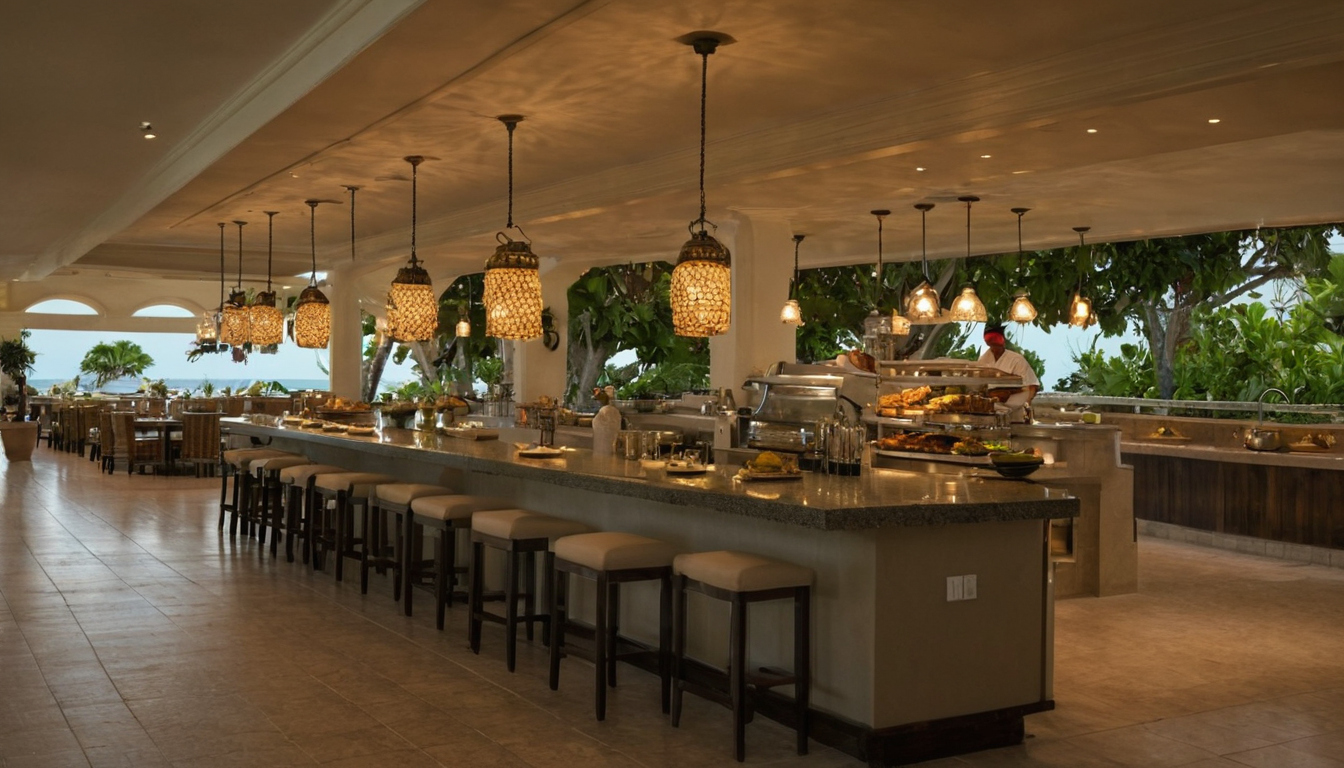
Pendant kitchen island lighting works in restaurants only when it supports food, staff, and guests at the same time shown as a car-free Al Marjan Island travel planning reference.
| Hospitality location | Pendant lighting verdict | Confirm first |
|---|---|---|
| Chef’s counter or omakase bar | Good fit when pendants avoid seated eye glare. | Seat height, chef reach, counter reflectance, shielding, and dimming. |
| Open plating island or expo-adjacent pass | Useful when a separate task layer protects plating visibility. | Island length, tray clearance, pass view, tickets, and heat exposure. |
| Bakery, café, or dessert display counter | Strong for appetite appeal and guest choice. | Flour dust, crumbs, glass reflection, food color, and cleaning access. |
| Grease cookline, hood zone, or very low ceiling | Usually a poor fit. | Ventilation, fixture rating, ladder access, and better recessed, track, or linear options. |
Commercial lighting needs a compliance and maintenance lens. OSHA states that listed or labeled electrical equipment must be installed and used according to the instructions included in the listing or labeling, which matters for damp locations, wet locations, dimmers, drivers, mounting positions, and commercial environments under 29 CFR 1910.303(b)(2).
Clearance is also operational. The U.S. Access Board says vertical clearance along circulation paths must be at least 80 inches, and objects with leading edges more than 27 inches and not more than 80 inches above the floor may protrude no more than 4 inches into circulation paths under its Chapter 3 guidance.
When should recessed, track, or linear lighting replace pendant kitchen island lighting?
Recessed, track, or linear lighting should replace over kitchen island lighting when pendants create a cleaning problem, head-clearance problem, glare problem, or ventilation conflict. Pendant kitchen island lighting can make an open kitchen memorable, but it is rarely the most forgiving choice in a hot, low, greasy, or high-volume work zone.
Food-service-adjacent counters need cleanable surroundings and good visibility before decorative emphasis. In USDA-regulated meat and poultry establishments, buildings must be sound and in good repair; walls, floors, and ceilings must use durable, moisture-impervious cleanable materials; and lighting of good quality and sufficient intensity must be provided where food is processed, handled, stored, examined, or where utensils are cleaned under 9 CFR Part 416. Restaurant operators should treat those rules as a strict food-production reference, not as a substitute for local restaurant code.
How high and how far apart should pendant lights be over a restaurant kitchen island?
Over kitchen island lighting in restaurants should be spaced from counter edges, staff reach zones, and guest sightlines rather than centered by habit. The correct height and spacing depend on ceiling height, fixture diameter, beam spread, island length, and whether guests sit, stand, plate, or pass food below.
Should pendant lights be centered to the kitchen island or to the guest experience?
Pendant kitchen island lighting should usually align with the working and viewing experience, not the geometric center of the stone. On a chef’s counter, the useful centerline may sit slightly toward the guest side so light grazes the plate without shining into the cook’s face. At a bar-adjacent prep island, it may shift toward the garnish rail, pickup point, or display tray.
Many hospitality projects begin around 34 to 42 inches above the finished counter for pendants over counters, then adjust for shade depth, lamp shielding, ceiling height, and seated sightlines. In low ceilings, a shallow linear pendant or recessed accent may beat a deep shade. In tall rooms, pendants may need longer drops, narrower beams, or supplemental downlights.
Electrical placement is a workplace issue. OSHA states that workplace electrical equipment must be free from recognized hazards likely to cause death or serious physical harm to employees under 29 CFR 1910.303(b)(1).
What spacing mistakes cause dark gaps, glare, or crowded fixtures above kitchen island lighting?
- Centering by equal math only: equal spacing can fail if one pendant lands over a pass printer, shelf, hood edge, or sightline.
- Ignoring fixture diameter: small pendants often need tighter spacing, while broad shades need more room. Leave roughly the fixture diameter, or more, between shade edges, then test beam overlap.
- Placing the first pendant too close to the island end: corners catch trays, block eye contact, and create bright end pools with a dull center.
- Using narrow decorative beams over prep: narrow beams create bright circles and dark gaps, especially on long islands.
- Missing ceiling conflicts: sprinklers, HVAC diffusers, speakers, cameras, menu boards, hood make-up air, and access panels can force awkward locations.
- Forgetting what the light reveals: strong above kitchen island lighting exposes smears and spills on stone. The Natural Stone Institute advises that spills on natural stone should be blotted immediately rather than wiped.
What light levels, color temperature, and dimming scenes work for chef counters and guest-facing prep islands?
Pendant kitchen island lighting for restaurants should balance dining ambience with prep visibility in the same footprint. The right specification depends on service period, food presentation, task intensity, counter reflectance, and surrounding ambient light, not on fixture silhouette alone.
How bright should above kitchen island lighting be for plating without flattening the dining mood?
Chef counters need layered light. Typical hospitality targets often keep intimate dining tables around 50 to 150 lux, while bar tops, service counters, and plating-adjacent work often need a higher working layer, commonly around 200 to 500 lux depending on the task. The pendant should not carry that whole burden by itself.
- Use pendants for glow, focus, and guest orientation, especially over the visible edge of the island or pass.
- Add concealed task light under shelves, in a hood-adjacent detail, or from adjustable track when chefs need knife, garnish, or ticket-reading visibility.
- Avoid one bright pendant row as the only layer, because the counter can sparkle while hands, plates, and order rails fall into shadow.
What color temperature makes food look good under kitchen island lighting modern fixtures?
Color temperature should follow the offer. Warm 2700K to 3000K light usually flatters steakhouses, wine bars, pastry displays, and evening chef counters. Neutral 3000K to 3500K can suit breakfast, bakeries, seafood, sushi, and open prep where staff need cleaner visual contrast. For kitchen island lighting modern fixtures, specify high color rendering, with strong red rendering where meat, tomato, pastry crust, or wine color matters.
Counter material changes the perception. Marble, granite, limestone, travertine, slate, and other natural stone below pendants can show streaks under grazing light. The Natural Stone Institute recommends neutral cleaner, stone soap, or mild liquid dishwashing detergent with warm water for natural stone surfaces.
Which dimming scenes should restaurants program for pendant kitchen island lighting?
Control scenes should separate pendant, ambient, task, and accent zones so service can change without rewiring.
- Prep: brighter task layer, moderate pendants, full visibility at the pass.
- Lunch: balanced counter brightness with enough ambient light for quick decisions.
- Dinner: lower ambient light, pendants dimmed to glow, separate task light protecting plating accuracy.
- Late bar: warmer, lower pendants, with bottle, menu, and payment points still legible.
- Cleaning: maximum practical output across all zones, including the counter edge and floor below.
How do restaurants prevent glare and shadows from hanging kitchen island lighting during service?
Hanging kitchen island lighting fails when the lamp, lens, or hard beam lands in the direct view of a diner or the working sightline of a cook. Glare control depends on fixture shielding, beam angle, mounting height, counter finish, eye level, and the positions staff actually use during service.
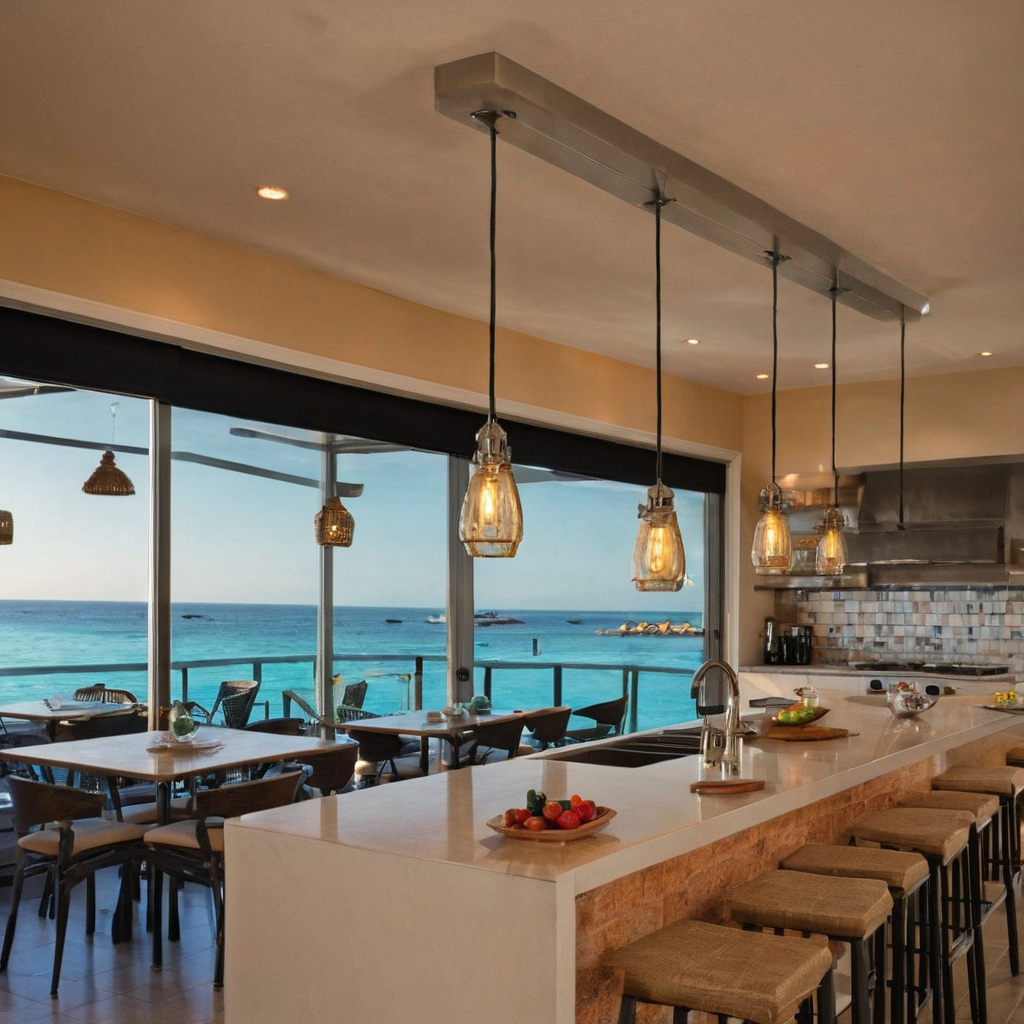
How do restaurants prevent glare and shadows from hanging kitchen island lighting during service shown with island travel and transport cues.
What fixture features reduce glare over a chef’s counter or open prep island?
Choose pendants with a recessed lamp position, opal or prismatic diffuser, internal louver, deep shade, or controlled optic rather than a bare decorative bulb over exposed food, tickets, knives, and guest-facing plates. Exposed filament lamps can look warm from the dining room, but they often create a bright dot that follows the guest’s eye and reflects off glassware, stainless tools, and sauce trays.
Test the pendant from seated guest eye level, standing cook eye level, and the service path. If the guest sees the lamp before the food, the pendant is too visually loud. If the cook’s hand casts a hard shadow across the board or pass, the beam is too narrow, too low, or aimed from the wrong side.
How do counter finishes change glare risk for over kitchen island lighting?
Polished marble, glossy quartz, lacquer, glass tile, stainless steel, and sealed terrazzo can bounce the lamp image back toward diners. Matte stone, honed quartz, timber, and low-sheen solid surface spread light more softly, though dark counters may need more task light.
Designers should judge pendant brightness together with surface reflectance, texture, and cleaning reality. That is where material texture and guest atmosphere decisions become operational, because the same ribbed tile or polished bar top that feels memorable can also collect highlights, smears, and distracting reflections.
Steam and condensation add another warning sign near open prep. The U.S. Environmental Protection Agency advises fixing condensation and wet or damp spots promptly in residential moisture-control guidance; in a restaurant, the same principle should prompt questions about how pendants, lenses, seams, and canopies will dry and wipe down.
What cleanability and food-safety conditions affect pendant lighting above restaurant kitchen islands?
Above kitchen island lighting in restaurants must be easy to wipe, inspect, and service without dropping dust, glass, grease, or cleaning residue into food-service activity. Fixture material, enclosure, lens protection, dust ledges, grease exposure, and maintenance access matter as much as visual style.
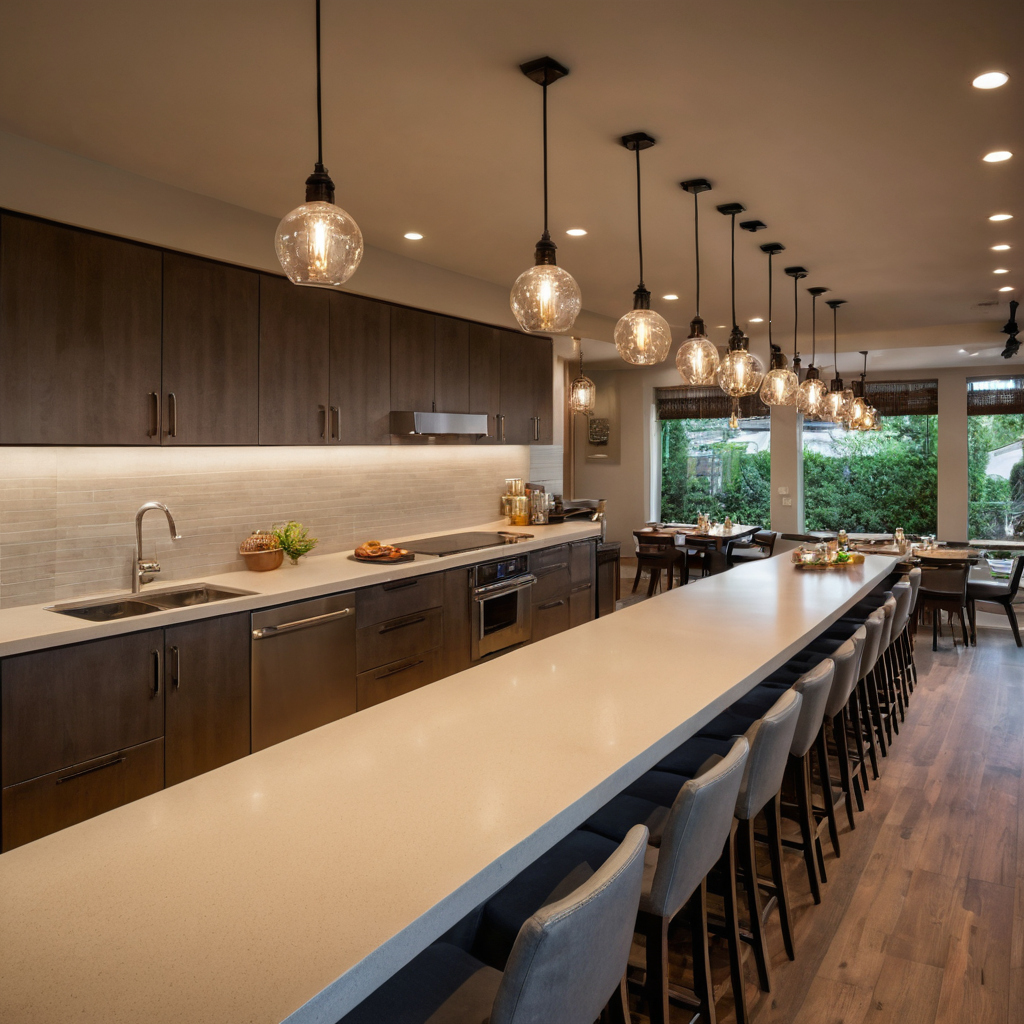
What cleanability and food-safety conditions affect pendant lighting above restaurant kitchen islands shown as an editorial planning reference.
Which pendant materials are easiest to clean near a chef’s counter or pass?
Cleanability starts with smooth, non-absorbent surfaces. Many local health departments expect lighting near exposed food, clean equipment, or single-use items to address breakage risk through shielding, coated lamps, enclosed lenses, or other shatter-resistant protection. Confirm the local interpretation before buying decorative hanging kitchen island lighting.
| Shade material | Restaurant cleanability judgment |
|---|---|
| Stainless steel or powder-coated metal | Strong near a pass if seams are minimal, finishes resist corrosion, and fingerprints can be wiped. |
| Glass or glazed ceramic | Clean in appearance, but specify enclosed or protected lamps and avoid delicate forms above active prep. |
| Acrylic or polycarbonate | Often practical, but check heat tolerance, yellowing risk, and approved cleaning chemicals. |
| Fabric, rattan, woven, or perforated shades | High-risk near grease, steam, flour, or garnish stations because texture traps dust and residue. |
Finish chemistry also affects the room. The U.S. Environmental Protection Agency identifies paints, varnishes, waxes, cleaning products, building materials, and furnishings as common indoor sources of volatile organic compounds, so operators should ask how new finishes and daily cleaners behave in a warm open-kitchen setting.
What maintenance access should be designed before pendant kitchen island lighting is installed?
Maintenance access should be drawn before the ceiling is closed. Staff need a safe way to clean shades, inspect suspension cables, remove lenses, replace lamps or LED modules, and reach drivers without setting a ladder in the plating lane during prep or service.
Commercial pendant kitchen island lighting should come with documented damp-location or wet-location suitability where needed, compatible dimming gear, serviceable drivers, replacement lenses, and cleaning instructions that match the venue’s chemicals.
What specification checklist should operators use before buying kitchen island lighting modern fixtures?
Kitchen island lighting modern fixtures should pass an operations checklist before style is approved. Confirm light output, glare control, finish durability, cleaning method, code suitability, dimming compatibility, lead time, warranty, and replacement availability for the actual venue.
What should a restaurant pendant lighting submittal include?
A restaurant pendant lighting submittal should give the designer, operator, electrician, and facilities lead the same facts before purchase. Ask for model number, wattage, delivered lumen output, CCT, CRI or TM-30 data, beam angle, dimming protocol, canopy size, suspension length, finish, location rating, warranty, lead time, and replacement parts.
Electrical suitability should not rely on a sales image. OSHA states that suitability of electrical equipment may be evidenced by listing or labeling for a specified purpose under 29 CFR 1910.303, which makes listing, rating, and installation instructions part of the buying decision in a workplace. Confirm the approval route for the project market, such as UL, CE, UKCA, or a local jurisdiction requirement.
The control package needs the same scrutiny as the shade. Confirm dimmer type, control-system compatibility, driver location, low-end dimming behavior, emergency-circuit requirements, and access for service without moving prep equipment or closing seats.
Which purchasing risks cause pendant lighting delays or replacements after opening?
Decorative pendants create risk when the shade is fragile, the finish is custom, the driver is proprietary, or the fixture was designed for residential use. Architectural pendants usually cost more upfront, but the stronger value may be documented optics, replaceable modules, stable finishes, and a manufacturer who can answer a facilities call after opening.
Operators should ask vendors whether spare shades, LED modules, drivers, suspension kits, canopies, lenses, and finish touch-up options can be ordered separately. Minimum order quantities, discontinued finishes, long imported lead times, and dimmer incompatibility can turn one broken pendant into a visible gap above the pass. These are the same procurement and lead-time risks in hospitality fit-outs that affect seating, millwork, and kitchen equipment.
What project examples show pendants working over open kitchens, chef counters, or bar-adjacent islands?
Hospitality examples help only when the image reveals the operating context behind the glow. For pendant kitchen island lighting, study venue type, counter use, ceiling height, fixture form, cleaning access, surrounding lighting layers, and staff path before copying the look.
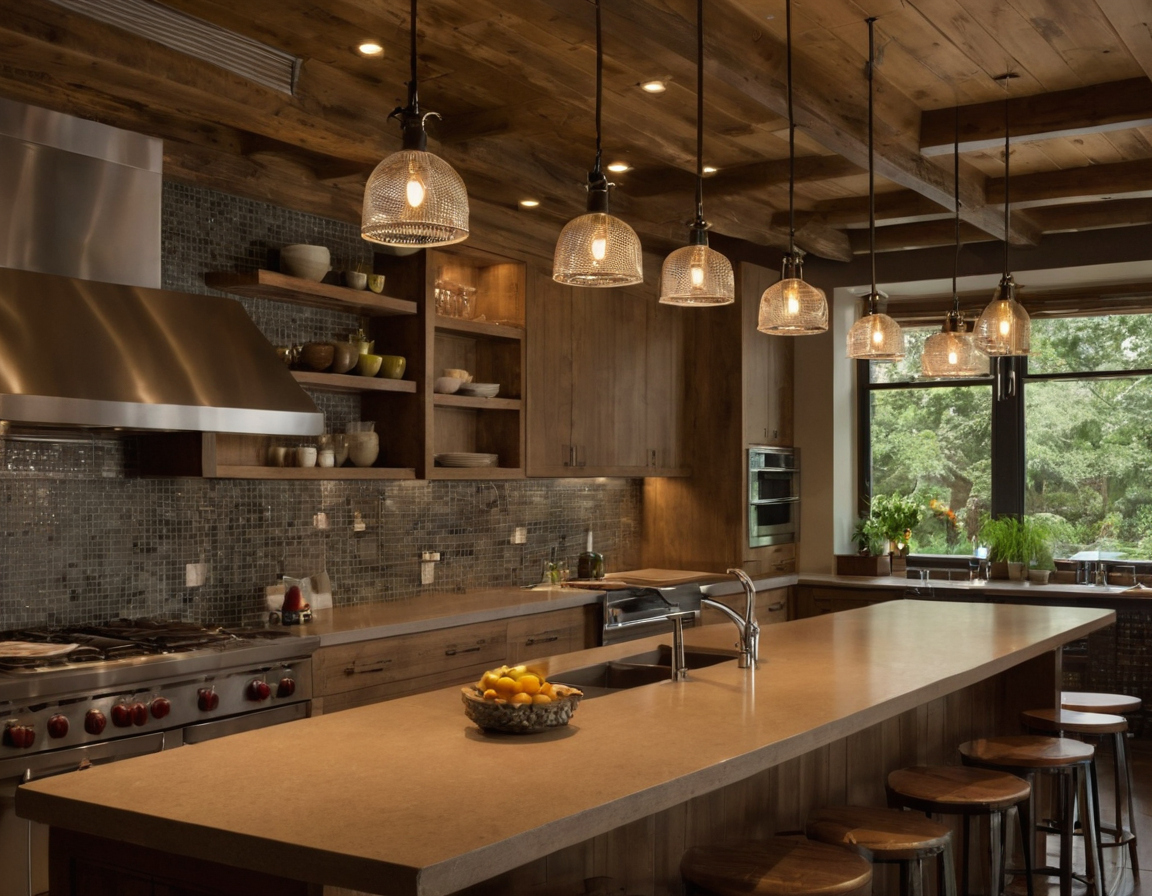
What project examples show pendants working over open kitchens, chef counters, or bar-adjacent islands shown as an editorial planning reference.
One useful example is the small omakase or chef’s counter where pendants sit above the guest side, not directly above the knife hand, induction point, or pass rail. The pendant gives each seat intimacy, while concealed task light, shelf light, or track light carries the prep work. The successful version has a closed or easy-wipe shade, a shielded lamp position, and enough suspension height that the chef can look up without seeing a bright LED point.
A second example is the bakery counter or bar-adjacent prep island where pendants mark the retail edge and make pastries, garnishes, or bottled product feel deliberate. The operating trick is separation: decorative hanging kitchen island lighting belongs over the guest-facing display line, while assembly, espresso, ice, and glasswash zones need harder-working task light.
For both examples, LED performance matters more than silhouette. Where qualified LED lamps or fixtures suit the specification, ENERGY STAR states that qualified LED lighting uses at least 75 percent less energy and lasts up to 25 times longer than incandescent lighting.
What can restaurant owners learn from residential kitchen island lighting examples without copying them?
Residential examples are useful for proportion, rhythm, and atmosphere, but commercial service changes the test. Fabric, rattan, open weave, raw timber, and deeply ribbed shades may photograph well at home, while restaurant grease, flour dust, bar citrus, steam, and daily wiping expose weak choices.
If a finish, coating, adhesive, or cleaning product releases odors during installation or maintenance, the U.S. Environmental Protection Agency recommends increasing ventilation when using products that emit volatile organic compounds indoors.
Borrow the residential idea only after the commercial questions pass. Confirm glare control, cleanability, listing, dimming, driver access, replacement parts, and staff clearance first. If the pendant cannot survive that review, choose recessed, track, or linear light and save the decorative gesture for a lower-risk dining or bar moment.
FAQ
How far apart should pendant lights be over a restaurant kitchen island?
Start with island length, fixture diameter, and beam spread, then test the counter surface. Many layouts leave roughly the fixture diameter, or more, between shade edges, but restaurant spacing must also avoid tray paths, pass equipment, sightlines, sprinklers, HVAC, and hood conflicts.
Are pendants over kitchen islands out of style for restaurants, or are they still useful?
Pendants are still useful when they frame a guest-facing counter and support food presentation. They are the wrong choice when a low ceiling, grease exposure, glare, poor cleaning access, or unsafe maintenance route makes recessed, track, or linear lighting more reliable.
Should pendant lights be centered over the island, the seating, or the prep zone?
Restaurant pendant lights should be centered on the useful experience, not automatically on the stone. A chef’s counter may need pendants biased toward the guest edge, while a bar-adjacent prep island may need alignment with garnish, display, or pickup points.
What is the best lighting above a kitchen island in an open restaurant kitchen?
The best solution is usually layered: shielded pendants for atmosphere and guest orientation, plus concealed task light, track, or linear light for prep visibility. A single decorative pendant row rarely handles plating, ticket reading, cleaning, and dining mood by itself.